Atlantic Pulse

U.S. narrative feasibility signals — and their implications for transatlantic decision-making. A GIS-exclusive brief for 2026.

Context

Why Now

Evidence

Pilot evidence (one chart that shows the mechanism)
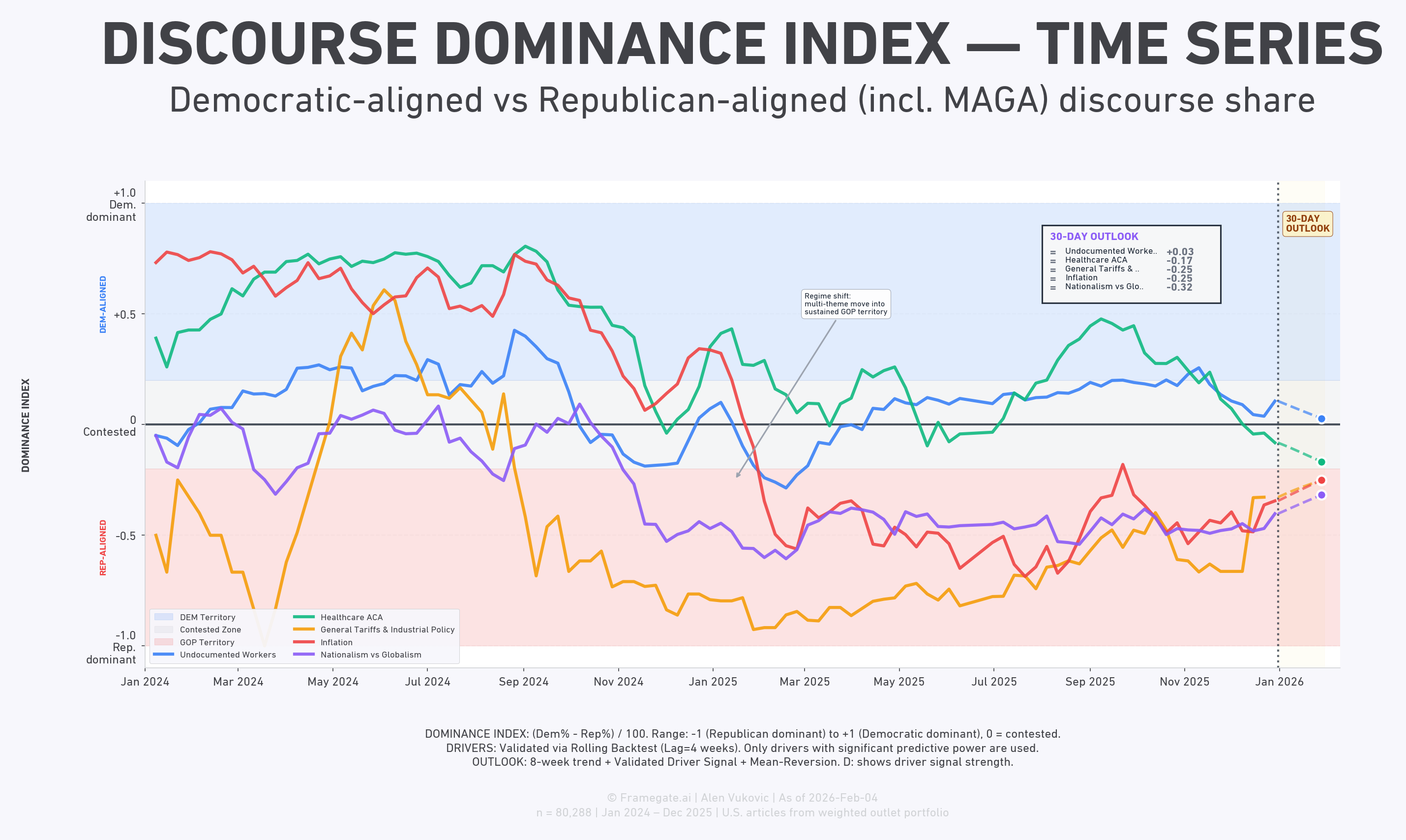
Discourse Dominance Index — Top themes from Jan 2024 to Jan 2026 with 30-day outlook

How to read

Values above zero indicate Democratic-aligned discourse dominance; values below zero indicate Republican-aligned (incl. MAGA) dominance; zero marks a contested zone. When multiple themes shift simultaneously, political feasibility often changes before institutions move — tightening or opening the space for policy and coordination.

What stands out since early 2025

Several high-salience themes shift into sustained one-side dominance, while others drift toward the contested zone. This pattern suggests a broader change in discourse balance rather than short-lived event noise.

So what (implications for European decision-makers)

  1. Reduced predictability: as more themes move into contested territory, U.S. policy constraints become more volatile and scenario planning gains priority over event-based expectations.
  2. Higher coordination cost: sustained dominance in alliance-relevant frames tends to increase transactionality and conditionality before formal decisions appear.
  3. Earlier warning window: these shifts provide lead time to adjust positioning and contingency options before debates harden into budget votes, summit outcomes, or executive action.

What to watch next

  • Consolidation vs reversal: does dominance persist, or does a counter-lane re-open the contested zone?
  • Calendar coupling: do shifts intensify around budget deadlines, major summits, or high-salience hearings?
  • Cross-theme alignment: do multiple themes move in the same direction at once (regime signal), or remain isolated (event signal)?

February 2026 — Key dates and triggers

Date Event Why it matters for Europe
Feb 6 Iran nuclear talks (Oman) Energy prices, sanctions coordination, Mideast risk
Feb 10 Election Integrity Hearing Trust-frames set early; US legitimacy as constraint
Feb 13 DHS Funding Deadline Calendar coupling with ICE debate; bandwidth in DC
Feb 13–15 MSC Munich Synchronization point; divergence vs common language
Feb 23+ Supreme Court (Cuba cases) Havana Docks v Royal Caribbean; Exxon v Cimex
Feb 24 State of the Union Agenda-setting; Europe as leverage or liability?
Iran Talks — Feb 6 (Oman)

What's scheduled: U.S.–Iran nuclear talks in Oman (per AP/Reuters).

Why relevant for Europe: Potential impact on energy prices, sanctions coordination, Mideast risk — and thus transatlantic alignment costs.

Triggers: Does the mandate stay "nuclear only" or expand to missiles/regional militias? Is it framed as diplomacy or ultimatum/deterrence in U.S. discourse? (Feasibility shift for next steps.)

MSC Munich — Feb 13–15

Fixed: Munich Security Conference, Feb 13–15, 2026.

Why it matters: MSC is a synchronization point — transatlantic themes either get a "common language" or show visible divergence.

What to watch: Which words dominate: "burden sharing / autonomy / deterrence / de-risking / escalation control" — these are your lane indicators. Whether Ukraine/China/NATO are framed as a package or as trade-offs (changes coordination costs).

State of the Union — Feb 24

Scheduled: Speaker Mike Johnson has invited President Trump to deliver the State of the Union address on February 24, 2026.

Why it matters: The State of the Union has been a narrative breakpoint in both 2024 and 2025 — when Trump delivered his first address of the new term. It sets the agenda and signals which themes will dominate the political year.

What to watch: Which topics are pinned as "national priority" (agenda-setting). Whether Europe/NATO/Ukraine/China are framed as leverage or as liability — this shapes the transatlantic coordination space for months.

Deliverables

What Atlantic Pulse delivers (monthly + triggered alerts)

The Discourse Dominance Index provides a direct view into U.S. domestic narrative dynamics — including how Europe is framed from the inside. The four analytical outputs translate these signals into decision-relevant formats including scenario forecasts for transatlantic planning:

Alerts (rare, triggered only): Narrative pressure spikes, dominant-lane consolidation, reversal/realignment near key calendar points, Europe-framing shifts, or velocity breakouts.
Integration

Fit with GIS (adds a sensor, not a competing product)

Atlantic Pulse is a front-end sensor layer that increases lead time for GIS scenarios and advisory work:

Engagement

Pilot (risk-minimised)

We recommend beginning with a focused pilot — first delivery: March 1, 2026 — to validate fit and calibrate outputs before committing to a longer engagement. During the pilot, content scope and visual formats can be adjusted based on your feedback, ensuring the final product aligns with GIS workflows. After the pilot, we can discuss frequencies and scope adjustments.

4-week pilot

  • One monthly-style brief (all four outputs)
  • Up to two triggered alerts
  • One review call

Evaluation

  • Earlier signal than standard monitoring
  • Scenario usefulness
  • Decision relevance for transatlantic planning
Stop/continue: If the pilot does not create clear decision value, it ends — no platform changes required.

Atlantic Pulse separates ideas (what is being proposed) from narrative mechanisms (why it becomes feasible). The output is not opinion: it is a disciplined way to identify feasibility shifts early and translate them into scenarios and watchlists.

Facts & method (brief)

What we measure

  • Narrative lanes: how strategic ideas are carried (frames, emotional carriers, conflict logics).
  • Momentum: adoption, consolidation, fragmentation, reversal over time.
  • Feasibility shifts: when a lane expands what is acceptable — or narrows coordination space.

What we observe (three layers)

  • Decision-layer signals (policy-relevant actors and institutional language)
  • Interpretation-layer signals (policy-adjacent media and expert ecosystems)
  • Public-layer uptake (only when it materially affects feasibility)

Reproducible workflow

  • Defined time window + defined source set + documented classification → aggregation → trend logic.
  • Forecast discipline: Most likely / less likely, tied to explicit triggers.

What this is not
Not polling. Not advocacy. Not partisan messaging. It is decision support under uncertainty.

What we mean by "idea" vs "narrative" (two SPOs)

Idea (S–P–O = Subject–Predicate–Object)
A minimal policy proposition that states a position.
Example: (S) The U.S. (P) should adjust (O) alliance commitments.

Narrative mechanism (SPO = Signal → Pathway → Outcome)
The carrier dynamics that determine whether the idea becomes politically feasible.

Example (Signal → Pathway → Outcome)

Signal: recurring language shifts from "burden-sharing" to "structural liability."

Pathway: carrier story moves from transactional bargaining to identity-based rejection.

Outcome: coordination becomes politically costly; commitments become conditional; bargaining posture hardens.

Why this matters: the policy proposition may look similar on paper, but the negotiation space changes radically depending on the carrier narrative.

2026 topic list (signals → feasibility → transatlantic implications)

Institutional feasibility (midterms cycle)
Governing legitimacy, institutional trust, budget authority, investigation politics
→ Implication: U.S. coordination capacity and policy continuity (2027–2028)

Alliance & security
NATO burden-sharing, Article 5 credibility, European autonomy, deterrence posture
→ Implication: cohesion vs transactional bargaining vs fragmentation pressure

Ukraine / Russia
Support vs settlement vs disengagement narratives; funding fatigue; escalation control
→ Implication: European security architecture and burden redistribution

Sanctions & economic statecraft
Enforcement vs carve-outs; fatigue vs escalation logic
→ Implication: alignment costs and durability of coordinated pressure

Energy & critical resources
LNG politics, industrial competitiveness, critical minerals, infrastructure security
→ Implication: trade-offs between security, price stability, and industry

Technology & industrial policy
Export controls, supply-chain security, semiconductor regimes, data governance
→ Implication: divergence vs alignment in tech blocs and regulatory spillovers

China / Taiwan risk discourse
Decoupling vs de-risking; alliance expectations; Pacific prioritisation
→ Implication: European strategic choices and second-order trade effects

Arctic / Greenland
Route access, resource narratives, security posture
→ Implication: recurring friction point with outsized alliance symbolism

Custom thresholds & alert rules (what triggers an alert)

Alerts are intentionally rare. They trigger only when a change becomes decision-relevant:

  • Narrative pressure spike: rapid, sustained momentum increase within a short window
  • Dominant lane consolidation: one lane becomes clearly dominant; counter-lanes collapse
  • Reversal / realignment: dominant lane weakens near key calendar points
  • Europe framing shift: partner vs burden/irrelevant/competitor balance changes
  • Velocity breakout: narrative moves from elite discourse into broad adoption faster than baseline

Each alert includes:
Shift summary (1 sentence) → scenario impact (2–3 bullets) → what to watch (3 triggers) → transatlantic implication (1 line)

How to proceed

If this signal layer is useful for your planning cycle, we suggest a short alignment call to confirm scope, priority topics, and alert thresholds.

First delivery can be provided within the next reporting window; a short review follows after four weeks to decide whether the format should be continued, adapted, or stopped.